Frequently Asked Questions
Moy Tung Ving Tsun Kung Fu
The Nature of Ving Tsun Kung Fu
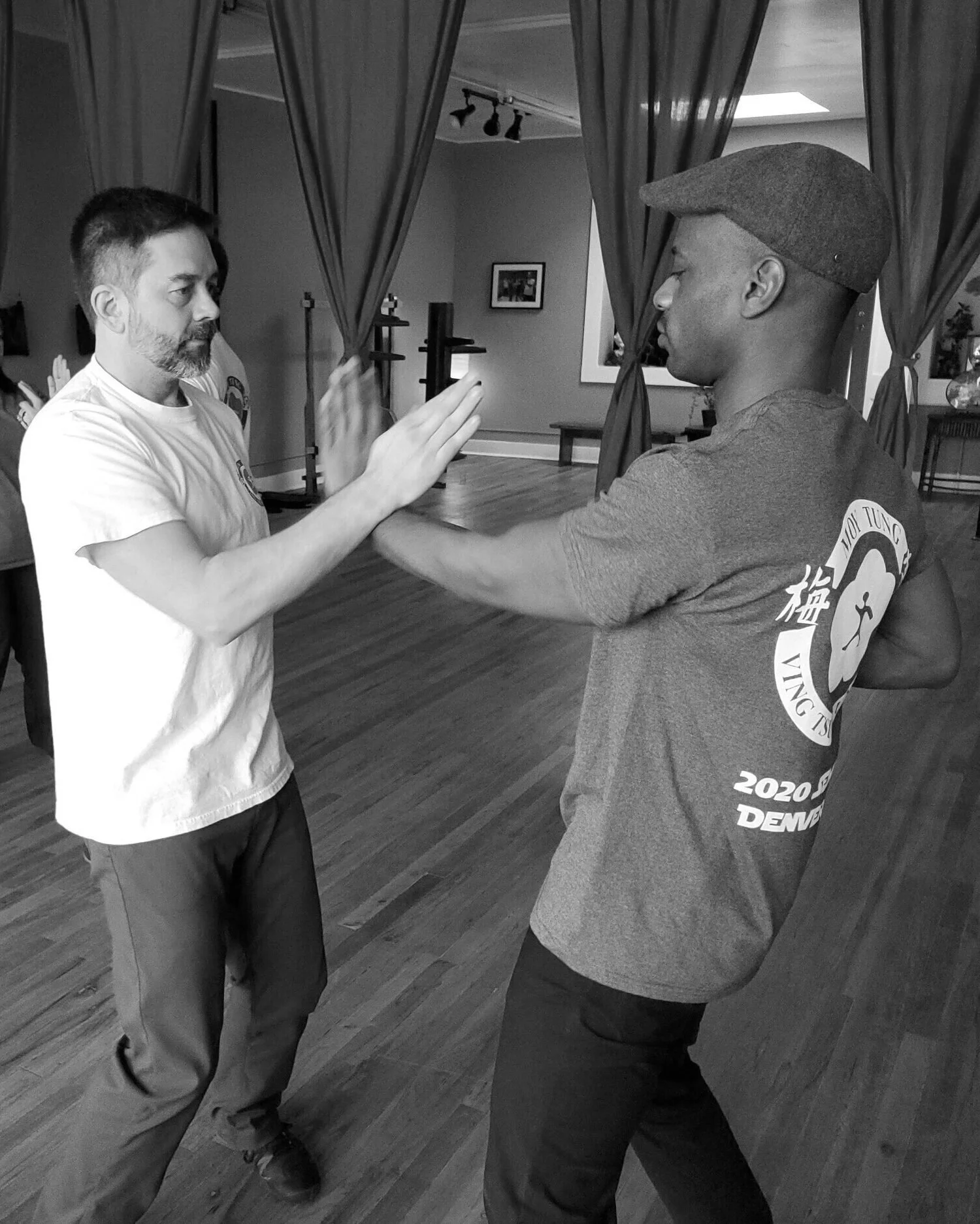
Daisihing Immanuel and his Sidai Mike practicing Don Chi Sao
What is Ving Tsun Kung Fu
Ving Tsun Kung Fu is a simple and beautiful martial art from ancient times that is well suited to the needs of people in modern society. It has been preserved and passed down through generations in its authentic form. It is a complete, traditional system of training. It is an amazingly efficient and effective system in which one can become competent in a relatively short time. Since it does not rely on physical strength, Ving Tsun is ideal for men and women of any stature.
How is Moy Yat/ Moy Tung Ving Tsun Kung Fu different from other martial arts?
Most martial arts are practiced as sports, and students of these arts are required to demonstrate their fighting abilities in competition. Ving Tsun, on the other hand, is not a sport, and students in Moy Yat/ Moy Tung schools are not expected to compete in tournaments. While it is typical for other martial arts schools to charge fees for rank promotions, there are no belt ranks or achievement tests in Moy Yat/ Moy Tung Kung Fu schools. In contrast to the strict military-style hierarchy and protocol common in other martial arts, students generally interact in a relaxed and informal way at schools in the Moy Yat/ Moy Tung family.
Are these differences meaningful?
One of the unique things about Ving Tsun is the way it’s taught. In the Moy Yat/ Moy Tung Ving Tsun Kung Fu Association, we do not simply teach “self-defense techniques” which may work in the controlled environment of a classroom but fail in the unpredictable “real world.” We teach principles of kung fu which can be applied to any aspect of life and which have been proven effective for four hundred years on battlefields, in tournaments, on the streets of Hong Kong and New York, and in the lives of the students of Ving Tsun.
What are some of the principles of Ving Tsun?
Ving Tsun trains the martial artist in “Centerline Theory.” Through forms and drills the hands are conditioned to occupy the body’s centerline, the best position from which to attack and defend. Economy of motion, simultaneous attack and defense, and relaxation are also at the heart of the Ving Tsun system.
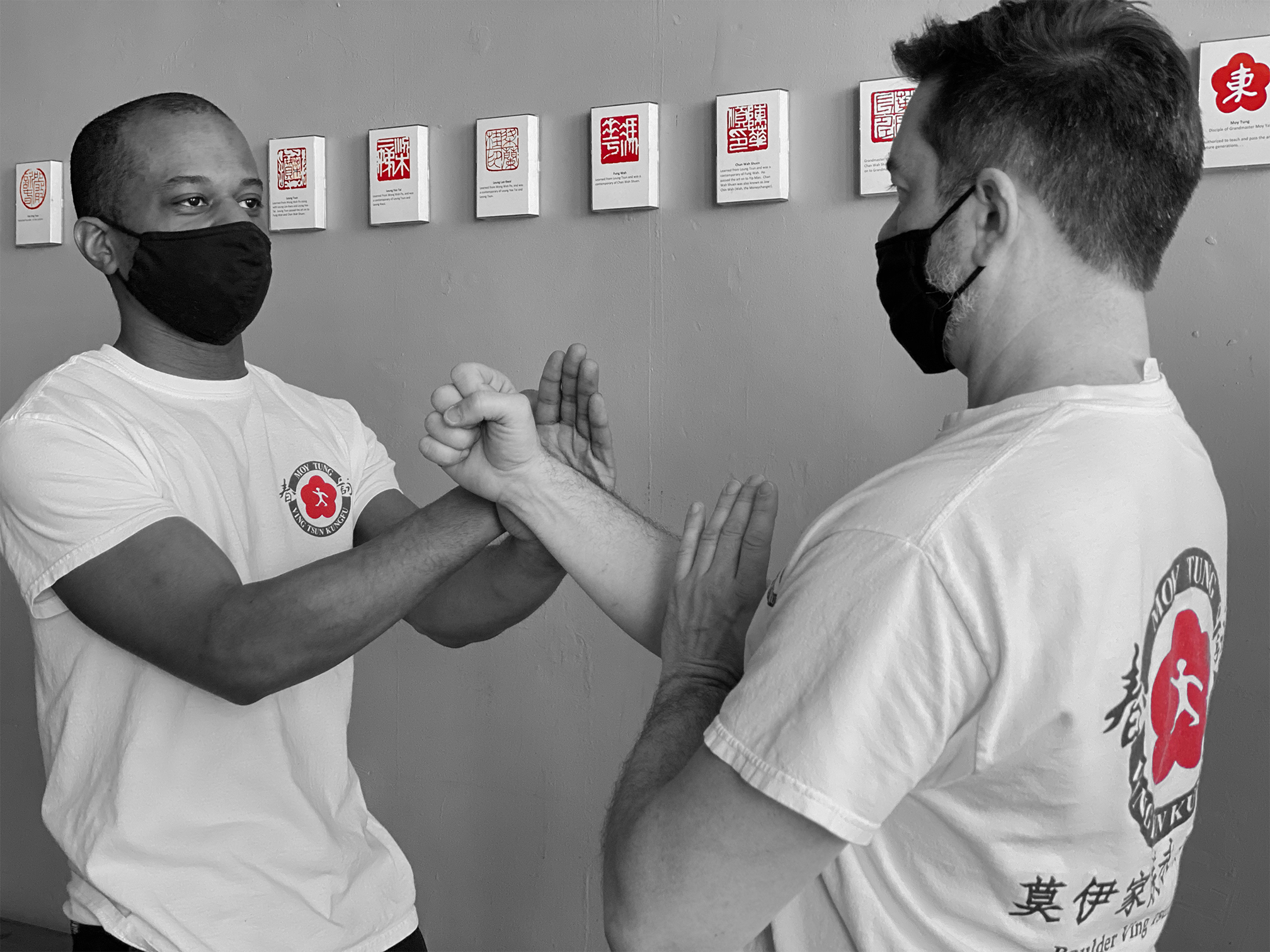
Daisihing Immanuel and his Sidai Mike - Pak Sao Drill
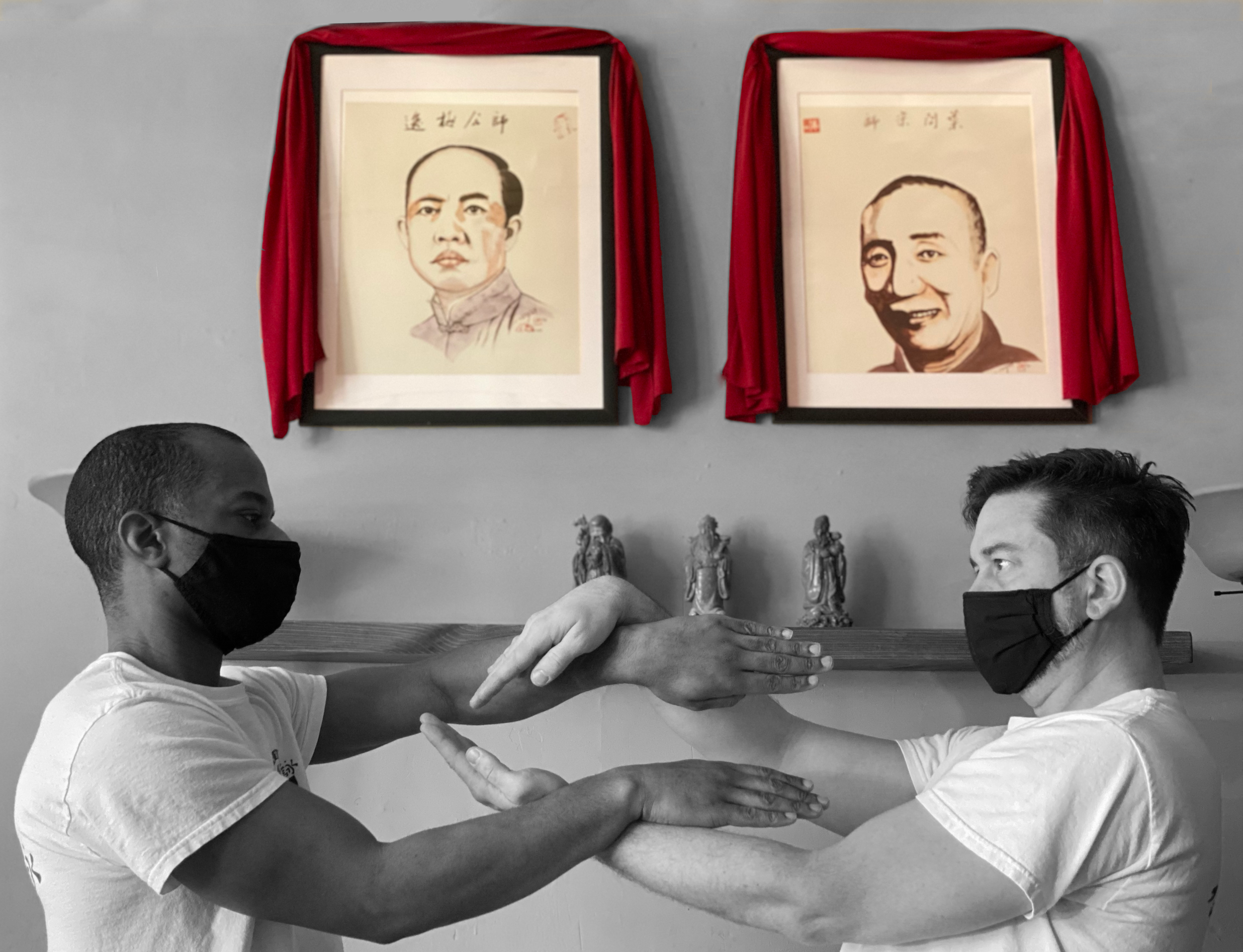
Daisihing Immaneul and his Sidai Mike practicing in front of the founders, Moy Yat and Yip Man
From what language does the terminology of Ving Tsun originate?
It originates from the Cantonese dialect of the Chinese language. Many Cantonese sounds cannot be accurately represented with the English alphabet. Different authors may use different English letters to represent the same Cantonese sound, so you may see a term spelled several ways. For example, the “moving the horse” drill may be written as toi ma, toy ma, toy mah, and tsui ma.
How is “Ving Tsun” pronounced?
It is commonly pronounced “wing chun” in America, although this is only an approximation of the Cantonese pronunciation.
The History and Lineage of Ving Tsun
What is the history and lineage of Ving Tsun?
Ving Tsun Kung Fu is named after its founder, Yim Ving Tsun, a woman who was born in a small town in southern China about 400 years ago. She studied kung fu with a nun named Ng Mui who was one of the top martial artists of the time. Yim Ving Tsun revised and refined what she had learned until finally she had a distillation that was amazingly economical as well as extremely effective. She taught the system to her husband, an actor named Leung Pok Toa. Together the two taught Ving Tsun Kung Fu to a carefully chosen few while traveling throughout China with Leung Pok Toa’s show. When they stopped in Fut Shan they taught a doctor, Leung Chun. He passed Ving Tsun on to Chan Wah Shuen, who in turn taught Yip Man. In 1949, Yip Man brought Ving Tsun Kung Fu to Hong Kong where it became the most popular style of kung fu. Among his students were the famous actor Bruce Lee and the man whose name this Kung Fu association bears, Moy Yat. Grand Master Moy Yat immigrated to New York in the 1970s and, thereafter, popularized Ving Tsun in America and around the world. Moy Yat’s student Moy Tung taught Moy Yat Tung, who is the sifu of Bryan Pierce. For more details, see the Moy Tung Ving Tsun Lineage, and the relationship to Sifu Bryan.
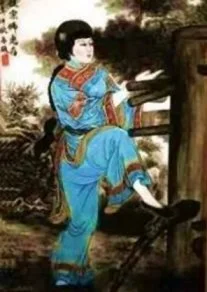
Yim Wing Chun the original Founder of Ving Tsun Kung Fu